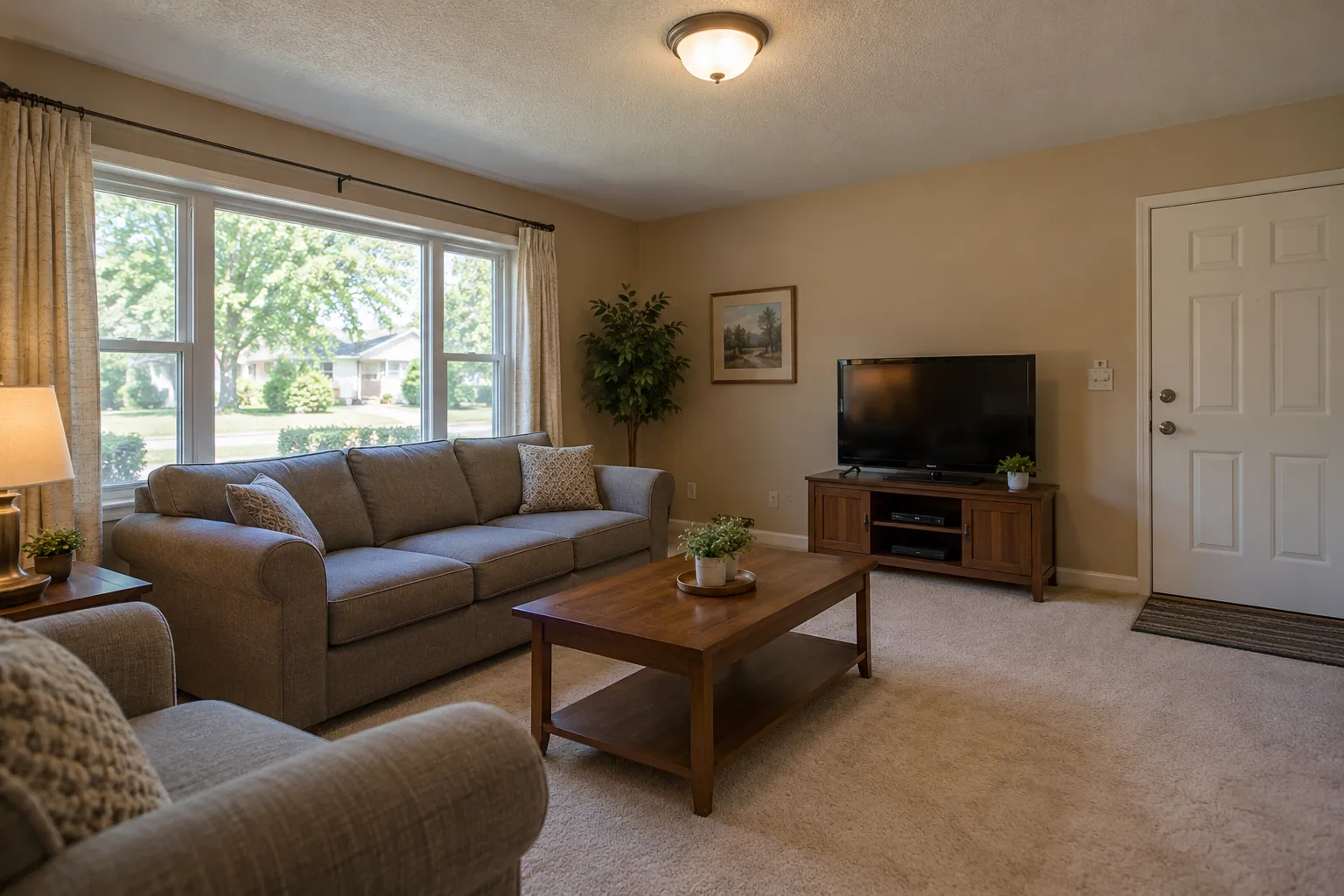
 Example photo, created with AI
- Beige walls and carpet
- A plain gray sofa
- Window on the left, door on the right
Your room today
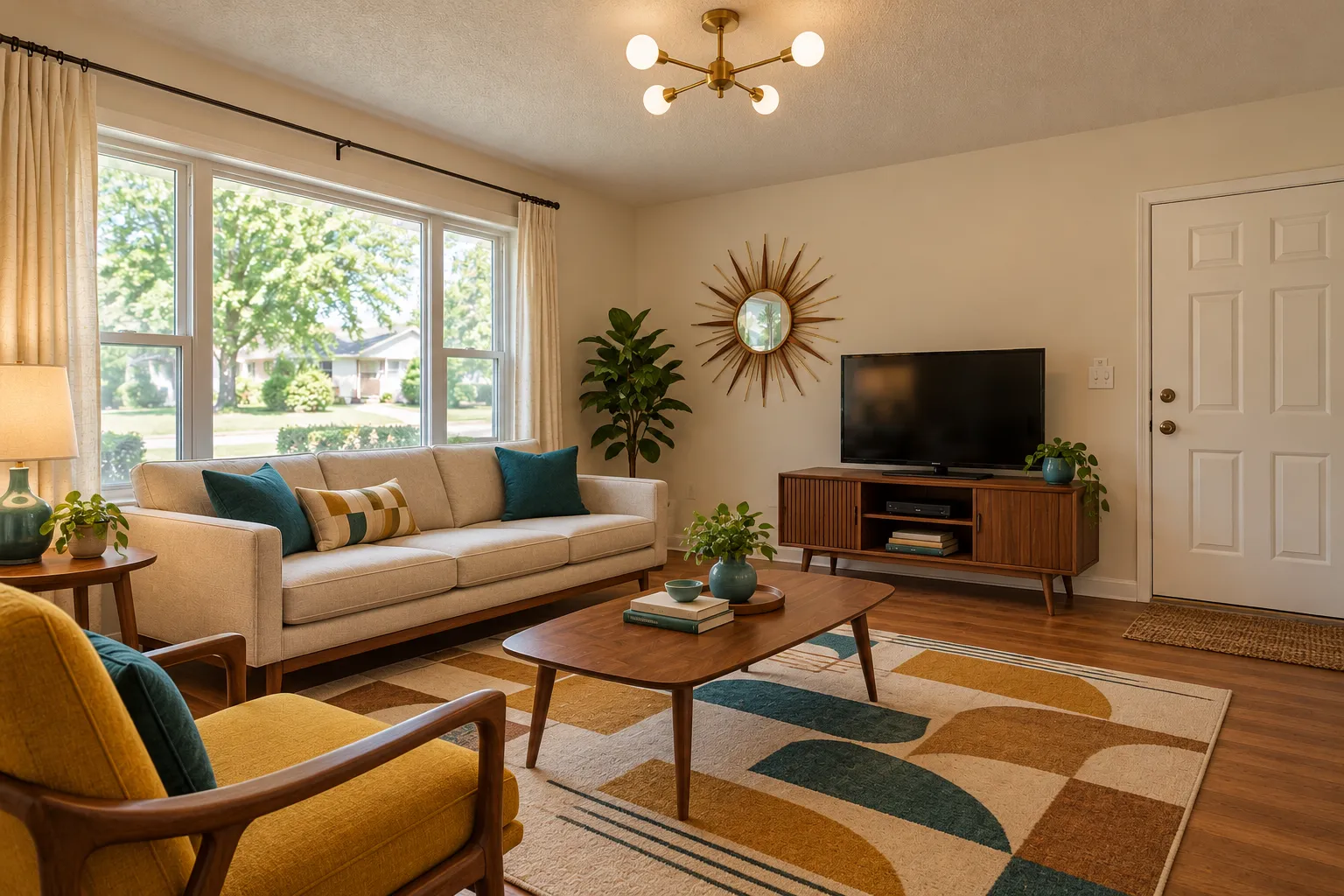
One living room, before and in the mid-century modern style · Scroll to explore
Mid-century modern interior design brings back the 1950s and 60s: walnut furniture on slim tapered legs, simple shapes, globe lights and a few warm colors like mustard and teal.
The same room before and in the mid-century modern style
Example photo, created with AIYour room today
Example designs, created with AI
 Your turnExamples created with AI
$9.90 for 50 credits, $19.90 for 150 or $39.90 for 500, paid once. No subscription.
Mid-century modern is the look of homes built from the end of the 1940s to the late 1960s, in America and in Scandinavia: open rooms, big windows and furniture that was new, light and made to be used. Designers worked in walnut, teak and molded plywood and kept the shapes simple.
Today it's one of the easiest styles to live with. The furniture stands on slim legs, so you see the floor and the room feels lighter; the wood is warm; and two or three colors, mustard, teal, olive or orange, keep it cheerful without getting busy.
Four things give it away, and this one living room has all four.
Example designs, created with AIThe sofa, the credenza and the tables stand on thin wooden legs that narrow toward the floor, so there's floor showing under nearly everything.
A warm, mid-brown wood with a visible grain on the credenza, the coffee table and the chair arms. It's oiled, not painted or distressed.
Mustard, teal, olive or burnt orange on one chair, the cushions and the rug, against cream walls. Two or three colors, not a rainbow.
A sputnik or globe light, a sunburst mirror, circles and arcs on the rug. Here: a brass sputnik light and a sunburst mirror over a walnut credenza.
Mid-century modern works almost anywhere. It's at its best in a living room or a bedroom, where a walnut bed or credenza and one colorful chair or throw do most of the work. In a kitchen or a bathroom it means walnut cabinets, colored tile and brass, and it's one of the safest styles for staging an empty room, because buyers of every age like it.
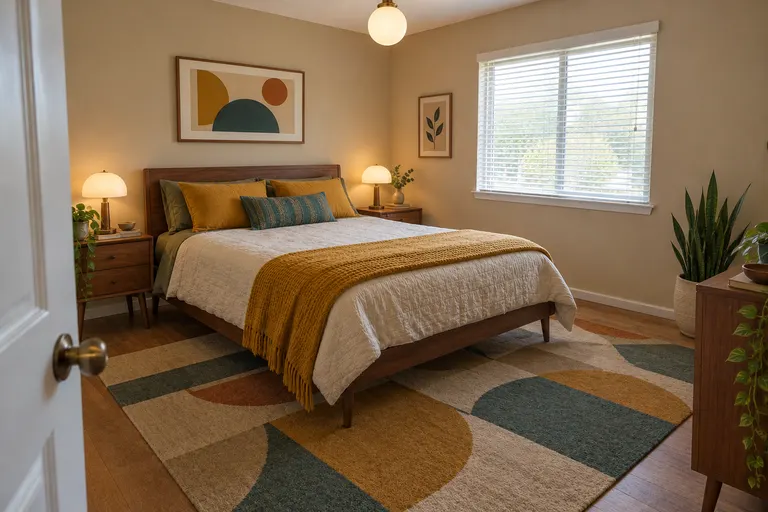 Example designs, created with AI
Walnut bed · Mustard and teal · Geometric rug
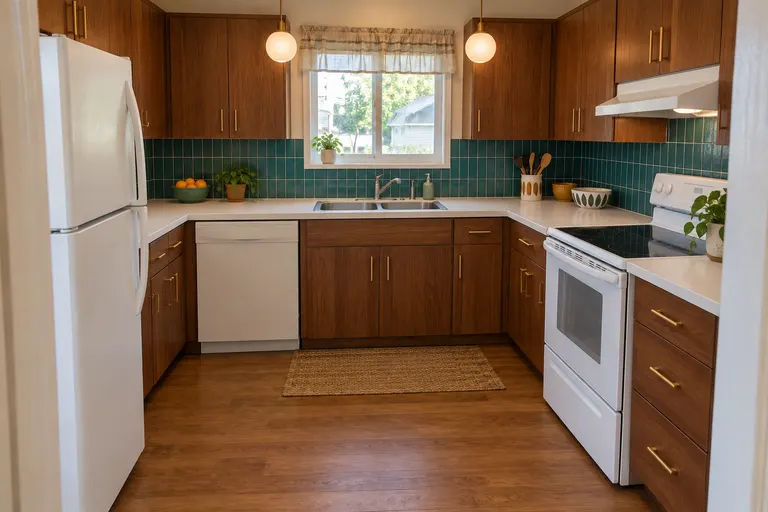 Example designs, created with AI
Walnut cabinets · Teal tile backsplash · Globe pendants
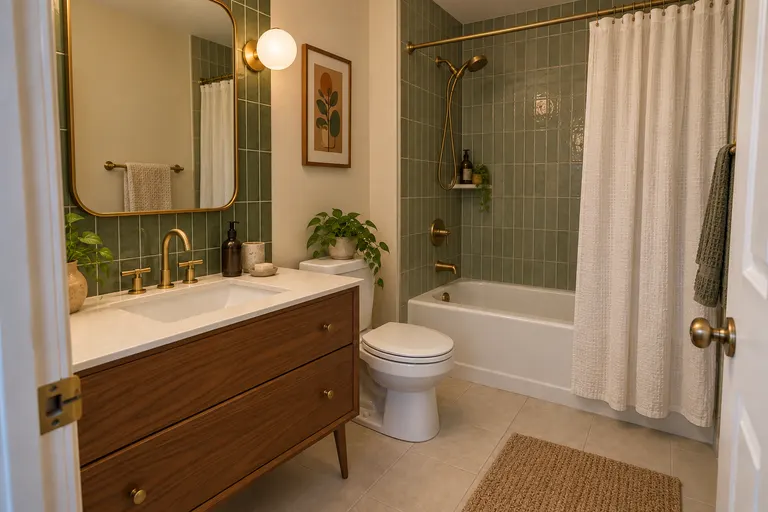 Example designs, created with AI
Walnut vanity · Green glazed tiles · Brass fixtures
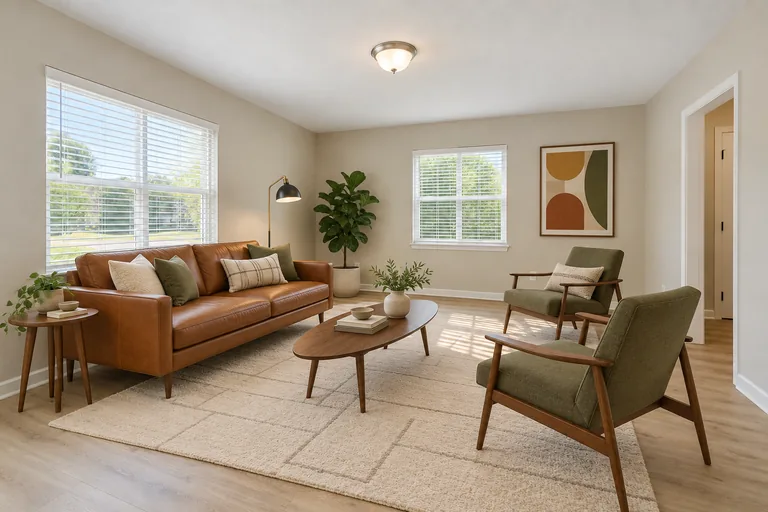 Example designs, created with AI
Cognac leather · Walnut table · Olive chairs
Example designs, created with AI. Each one starts from an ordinary room, so you can see what changed.
Start from warm white or cream walls and a mid-brown wood. Then pick two accent colors from the period, mustard and teal, olive and orange, or teal and rust, and use them on fabric, tile and art rather than on every wall.
For materials: walnut or teak, molded plywood, leather in cognac or tan, wool and tweed upholstery, brass, and white glass for the lights. Patterns stay simple and geometric: circles, arcs and blocks of color.
A room where every piece is a reproduction of a famous chair looks like a store. Keep one or two statement pieces and let the rest be plain.
Walnut floors, walnut paneling and walnut furniture in one room blur into brown. Keep the walls light and break the wood up with fabric, a rug and plants.
Mustard, teal, orange, olive and red together tip it into a theme party. Two accent colors are enough.
An overstuffed sofa that sits on the floor hides the slim legs that make the style. Choose pieces that stand up off the floor.
Example photo, created with AIExample designs, created with AIBefore
Mid-century modern
Or see it first: upload a photo of your room below and pick Mid-century modern. The walls, windows and camera angle stay; the furniture, colors and decor change.
Mid-century modern is already picked. Choose your room, upload a photo and generate.
Your photo
Tip: stand in a doorway or corner and fit the whole room in one wide photo, floor to ceiling. Close-ups of one corner give odd results.
Style
Examples created with AI.
Size
about 1 megapixel · 1 credit
Your image will show up here.
Designs are made with OpenAI's GPT Image 2.5. The AI is asked to keep your walls, windows and camera angle. Compare the result with your photo before making real changes.
The style of homes built from about 1945 to 1970: simple, low furniture on slim tapered legs, warm walnut and teak, open space and a few bold colors such as mustard, teal and orange.
Warm white or cream walls and walnut wood, plus two accents from the period: mustard and teal, olive and orange, or teal and rust. Gray and charcoal work as quiet backgrounds.
Modern, as the word is used today, is cooler and smoother: white, gray and black, sleek low pieces and little wood grain. Mid-century modern is warmer and a little retro, with walnut, tapered legs and color.
Yes, it mixes easily. A mid-century credenza or chair sits well in a Scandinavian or a modern room. Keep the wood tones close and repeat the accent colors once or twice.
Yes. Upload a photo of your room and pick Mid-century modern: you get the same room back with mid-century modern furniture, colors and decor, and the walls, windows and camera angle stay. A design at the standard size uses 1 credit, and the packs are $9.90 for 50 credits, $19.90 for 150 or $39.90 for 500, paid once.
More style guides: Japandi interior design, Art Deco interior design, Minimalist interior design, Boho interior design, Industrial interior design, Traditional interior design, Coastal interior design and French country interior design.
More rooms: AI living room design, AI bedroom design, the AI room design home page, or AI interior design with one living room in all fifteen styles.